
Maths
Aims
We aim to provide a stimulating and exciting learning environment that takes account of different learning styles and uses appropriate resources to maximise teaching & learning.
The purpose of mathematics at Skelton Primary is to develop:
- positive attitudes towards the subject and awareness of the relevance of mathematics in the real world
- competence and confidence in using and applying mathematical knowledge, concepts and skills
- through a process of enquiry and investigation, an ability to solve problems, to reason, to think logically and to work systematically and accurately
- initiative and motivation to work both independently and in cooperation with others
- confident communication of maths where pupils ask and answer questions, openly share work and learn from mistake
- an ability to use and apply mathematics across the curriculum and in real life
Implementation
Planning
Years R-6 use the White Rose Maths Hub schemes of learning to guide and help structure their planning. This provide teachers with exemplification for maths objectives which are broken down into fluency, reasoning and problem solving. Planning and teaching support a mastery approach to teaching and learning and have number at their heart. Planning and teaching supports the ideal of depth before breadth and provides lots of opportunity to build reasoning and problem-solving elements into the curriculum.
EYFS have termly objectives that could be supported by white rose planning at teachers’ discretion.
UFOs – Using Four Operations
UFOs are our daily activity which are designed to develop pupils’ arithmetic skills as well as provide an opportunity for key dialogue around reasoning and justification of their methods.
Factual Fluency
Pupils take part in a daily activity to develop their mental maths skills. This generally occurs at the start of the lesson and is a basis for the skills required in the main teaching. This may include –
• Counting activities
• Teaching of mental strategies e.g. bridging, compensation for 9 etc.
• Teaching of times tables
The teaching of times tables facts should be planned as a series of activities and consolidation should be part of both the daily Maths lesson thereafter across all areas of Maths as well as the use of Times Table Rockstars. Children should understand the times tables facts and related division facts. They should be able to explain methods used and patterns identified, using mathematical language.
Mental strategies introduced in each year group are set out in the mental strategies pathway.
Times Table Rockstars
Times Table Rockstars is an app that is used to improve recall accuracy, provide consolidation and above all promote pupils’ engagement in times tables. Pupils are introduced to the app in year 2 and once they get to KS2, it is recommended they spend 5 minutes daily on the app practising their recall of times tables
Features of maths in the Foundation Stage
Mathematics within the EYFS is developed through purposeful, play based experiences and will be represented throughout the indoor and outdoor provision and maths is seen an ‘real’ experiences throughout class routines, and environments. The learning will be based on pupils’ interests or current themes and will focus on the expectations from Early Years Foundation Stage Framework. As the pupils’ progress, more focus is placed on representing their mathematical knowledge through more formal experiences. Pupils will be encouraged to record their mathematical thinking when ready and this will increase throughout the year using the concrete, pictorial abstract readiness.
Foundation Stage Classroom Routines and Learning Environments
- Mathematical Resources: Resources are clearly labelled to support early mathematical concepts such as colour recognition, size, quantity, and number awareness.
- Resource Organisation: Use of shadowing and visual prompts encourages children’s independence, mathematical thinking, and respect for their learning environment.
- Daily Mathematical Opportunities: Routine activities—such as counting out snack portions, voting for stories, and managing number-based limits in continuous provision—provide meaningful and embedded opportunities for mathematical learning.
The EYFS Framework in relation to mathematics aims for our pupils to:
- develop and improve their skills in counting
- understand and use numbers
- calculate simple addition and subtraction problems
Features of maths in Key Stage One and Two:
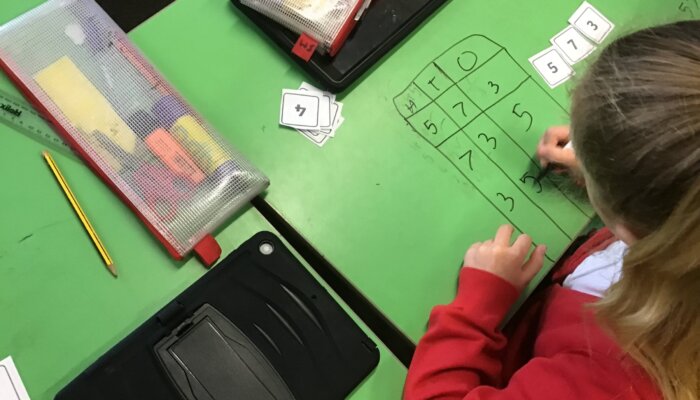
Teachers follow the Concrete Pictorial Abstract (CPA) approach to the teaching of maths. The CPA approach builds on children’s existing knowledge by introducing abstract concepts in a concrete and tangible way. It involves moving from concrete materials to pictorial representations, to abstract symbols and problems. Concrete apparatus is used throughout school to support in the CPA approach to maths.
Concrete representation – The children are first introduced to an idea or a skill by acting it out with real objects. This is a ‘hands on’ approach using real objects and it is the basis for conceptual understanding.
Pictorial representation – This is used when a child has sufficiently understood the hands-on experiences performed and can now relate them to representations, such as a diagram or picture of the problem. The use of iPads for visual representation is also utilised.
Abstract representation – The symbolic stage – a pupil is now capable of representing problems by using mathematical notation. The abstract stage involves the teacher introducing abstract concepts (for example, mathematical symbols). Children are introduced to the concept at a symbolic level, using only numbers, notation, and mathematical symbols (for example, +, –, x, ÷) to indicate addition, subtraction, multiplication or division.
Impact
In order to effectively design tasks it is imperative that the classroom teacher understands fully the success that pupils have had with their learning. We use our purpose built App to track skills progress across Maths.
It is worth noting that we define success in our curriculum beyond the assessment of the foundation subjects. We also look to build self –belief and respect so that all children develop a sense of self-worth. We hope to see the children realise new skills and find new interests and talents along their learning journey.
If you would like to know more about our Maths curriculum, please email office@skeltonprimaryschoool.co.uk