Art and Design
Intent
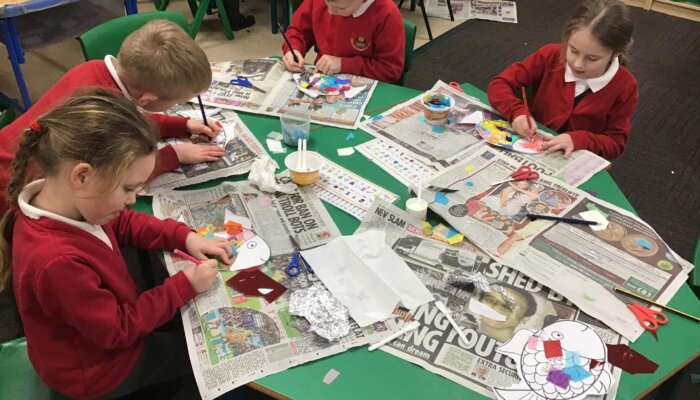
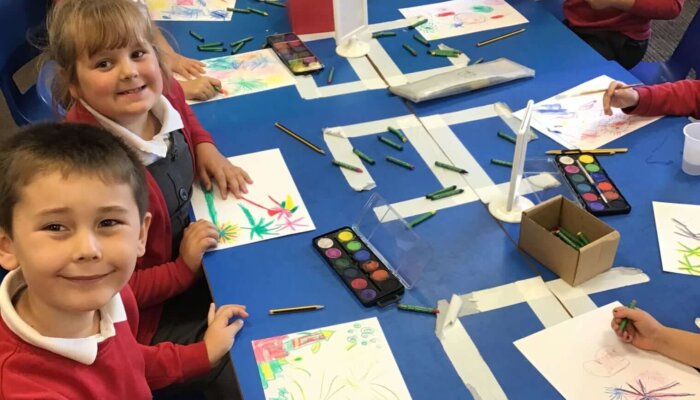
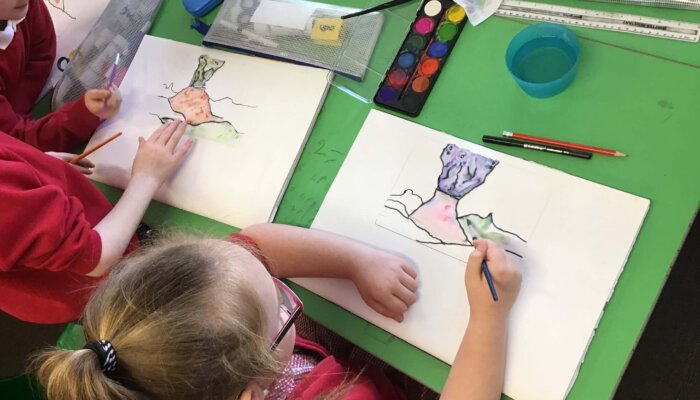
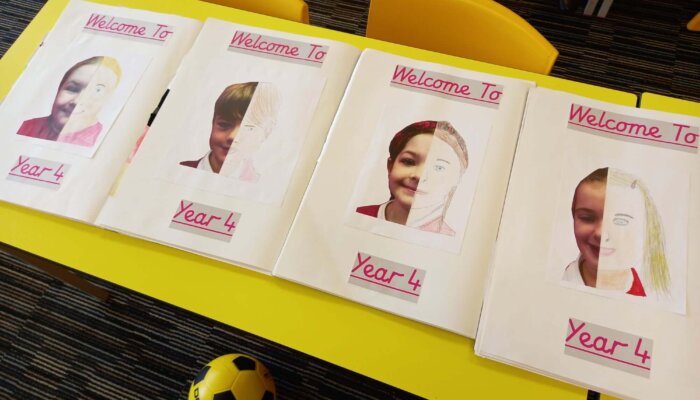
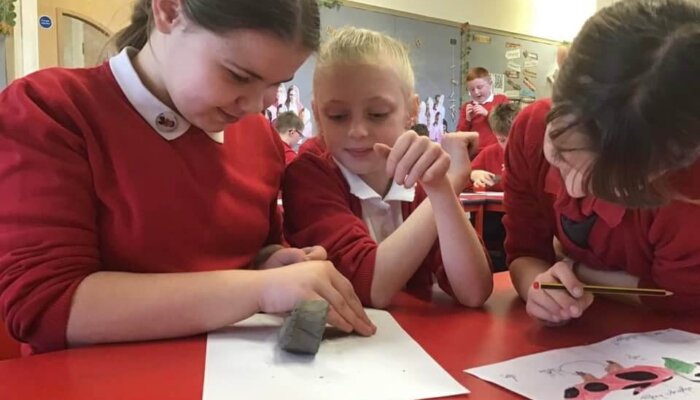
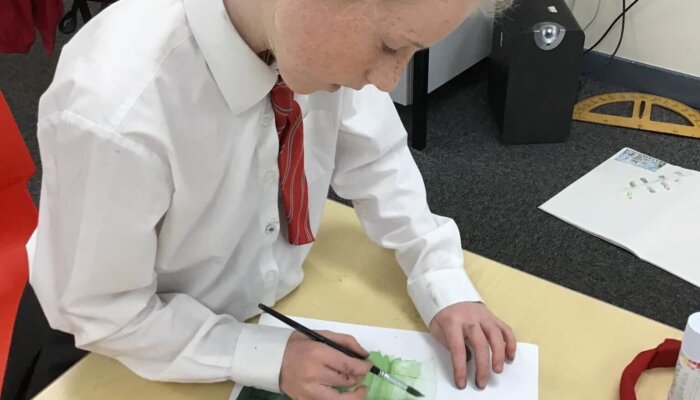
As artists, our children are offered opportunities to invent and create their own works of art. We equip them with the vocabulary to allow them to learn about and discuss great artists from cultures around the world. Our children are offered opportunities to practice skills, reflect upon and refine their own works of art allowing them time to adapt before coming to an end piece. We hope to raise our children’s aspirations by teaching them the skills they develop in their time with us will lay the foundations for opening the doors allowing them to become the graphic designers, interior designers or architects of the future.
Implementation
Ready, Reflective, Respectful, Responsible, Resilient
Vision
Across school we aim to put Art in context. This means that the children learn about art through artists and explore a range of media produced by famous artists. We explore specified artists and what influenced their artistic choices. Teachers share with them children techniques used by arties and provide opportunities to develop these skills in context.
In Early Years
In the Early years we aim to provide opportunity to develop skills that will enable them to be creative and use control when drawing and painting.
| Early Learning Goals | Physical Development | Fine Motor Skills | Hold a pencil effectively in preparation for fluent writing – using the tripod grip in almost all cases. • Use a range of small tools, including scissors, paintbrushes and cutlery. • Begin to show accuracy and care when drawing. |
| Expressive Arts and Design | Creating with Materials | Safely use and explore a variety of materials, tools and techniques, experimenting with colour, design, texture, form and function. • Share their creations, explaining the process they have used. |
In Key Stage 1
In line with the National Curriculum we aim to provide opportunities for children to :
- use a range of materials creatively to design and make products.
- to use drawing, painting and sculpture to develop and share their ideas, experiences and imagination
- to develop a wide range of art and design techniques in using colour, pattern, texture, line, shape, form and space
- about the work of a range of artists, craft makers and designers, describing the differences and similarities between different practices and disciplines, and making links to their own work.
| Year A | ||
| Collage Henri Matisse How can I produce art like Henri Matisse? Knowledge about Pablo Picasso Henri Matisse was born in France in 1869. He used bright and bold colours in his art. 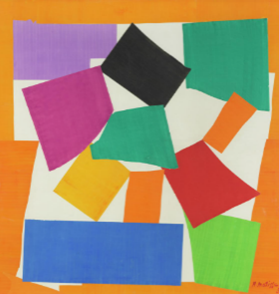 The Snail, 1953 | Painting Pablo Picasso What inspired Pablo Picasso to pick up a brush? Knowledge about Henri Matisse Pablo Ruiz y Picasso was born in Spain in 1881. Picasso painted lots of portraits and faces and used a range of lines in his art. 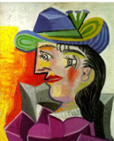 Woman with a blue hat, 1939 | Sculpture Jeff Koons Does he really use balloons? Knowledge about Jeff Koons Jeff Koons was born in the USA in January 21, 1955. He is an artist that makes sculptures of everyday objects, including balloon animals produced in stainless steel with mirror-finish surfaces. 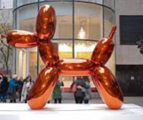 Balloon Dog Orange, 2013 |
| Year B | ||
Expressionism through collage Paul Klee Question 1— Does it matter which colours I use? Knowledge about Paul Klee He was born in 1879 in Switzerland. He finished over 9000 pieces in his lifetime. 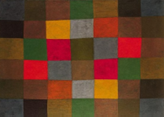 New Harmony, 1936 | Cubism through painting Giuseppe Acrimboldo— Question 2—What inspired Pablo Picasso to pick up a brush? Knowledge about Giuseppe Acrimboldo He was born in 1526 in Italy He is a renaissance painter who painted portraits with everyday objects. 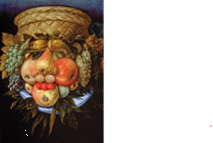 Feast for the eyes | Sculpture Alberto Giacometti Question—What material is best for stretching? Knowledge about Alberto Giacometti was born in Switzerland, 1901. He is known for his sculptures of human figures. As he got older, his sculptures become more elongated. 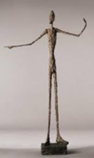 L’Homme au doigt , 1947 |
In Key Stage 2
In Key Stage 2 we aim to provide opportunities to refine technique and control through using a range of materials. Children:
- to improve their mastery of art and design techniques, including drawing, painting and sculpture with a range of materials [for example, pencil, charcoal, paint, clay]
- about great artists, architects and designers in history.
Lower Keys Stage 2
| Year A | ||
Impressionism through painting Claude Monet Question 1— What influenced Claude Monet? Knowledge about Claude Monet Claude Monet was born on 14th November in Paris, France. H The “father of impressionism”. Small, visible brushstrokes, unblended colour and an emphasis on the accurate depiction of natural light. 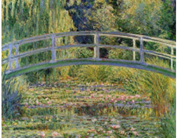 The Water Lily Pond, 1899 | Modernism through printing Andy Warhol Question 2— How do all the cans look the same? Knowledge about Andy Warhol Andy Warhol was an American artist He led the pop art movement,. Warhol is considered one of the most important American artists of the second half of the 20th century. 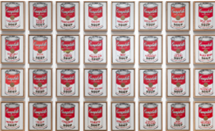 Campbell’s Soup Cans, 1962 | Sculpture Richard Long Question—How difficult is it create a sculpture out of natural materials? Knowledge about Richard Long Sir Richard Julian Long, CBE, RA (born 2 June 1945) is an English sculptor and one of the best-known British land artists. His work is inspired by the natural environment and he uses natural materials in his sculptures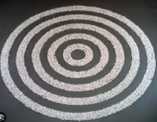 Small White Pebbles, 1987 |
| Year B | ||
Impressionism through drawing Pierre Renoir Question 1— What influenced Claude Monet? Knowledge about Pierre Renoir Renoir was born in France in 1841. He was good friends with Claude Monet. He used broken brush strokes. He enjoyed sketching and drawing outdoors. 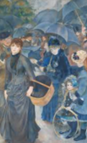 The Umbrellas, 1886 | Modernism through painting Jackson Pollock Question 2— Is this as easy as it looks? Knowledge about Jackson Pollock Paul Jackson Pollock was an American painter. A major figure in the abstract expressionist movement,. Pollock was widely noticed for his “drip technique” of pouring or splashing liquid household paint onto a horizontal surface. 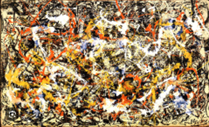 Convergence, 1952 | Sculpture Henry Moore Question—How difficult is it create a sculpture out of natural materials? Knowledge about Henry Moore He was born in Yorkshire in 1898 Henry Moore is famous for his sculptures of people with bumpy forms and hollow spaces in their bodies 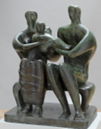 The Family Group, 1950 |
| Art skills Sculpture -Create and combine shapes to create recognizable forms (e.g. shapes made from nets or solid materials) – Include texture that conveys feelings, expression or movement – Use clay & other mouldable materials (modroc) – Add materials to provide interesting detail. Drawing – Use hatching and cross hatching to show tone and texture -Select & arrange materials for a striking effect -Ensure work is precise. Painting – Mix colours effectively – Use watercolour paint to produce washes for backgrounds then add detail – Experiment with creating mood with colour. Textiles -Shape & stitch materials – Use basic cross stitch & back stitch. | ||
Upper Key Stage 2
| Year A | ||
Graffitti through painting Banksy Question 1— Who is Banksy? Knowledge about Banksy We do not know who he is—he has always remained anonymous. He has been active since the 1990s His work first appeared in Bristol His work often carries a political message 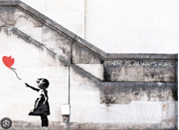 Girl with balloon, 2004 | Surrealism through printing Salvador Dali Question 2— Why are the clocks melting? Knowledge about Salvador Dali Salvador Dalí (born May 11, 1904, Figueras, Spain—died January 23, 1989, Figueras) was a spanish Surrealist painter and printmaker, influential for his explorations of subconscious imagery. 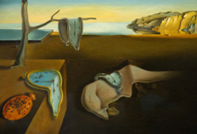 Persistence of Memory, 1931 | Sculpture Otobong Nkanga Question 3 – How does the environment influence art? Knowledge about Otobong Nkanga Nkanga was born in Nigeria. She is influenced by the natural environment and the need to protect it 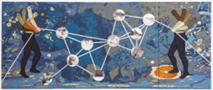 The Weight of Scars, 2015 |
| Year B | ||
| Graffitti through painting Kobra Question — Who is Kobra? Knowledge about Kobra Eduardo Kobra is a Brazilian street artist who began his career in 1987 at 11 years old, in his hometown of São Paulo. Since then he has painted over 3,000 murals on five different continents. 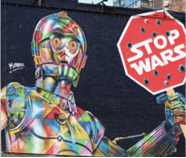 Stop Wars, 2012 | Surrealism through drawing Frida Kahlo Question – Why so many self-portraits? Knowledge about Frida Kahlo Frida Kahlo, was a Mexican painter. She was known for her surreal and very personal works. She is famous for her self portraits. 55 of her 143 paintings were self portraits, rich in symbolism and Mexican folklore 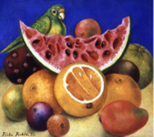 Still life of watermelon and bird,1951 | Textiles – Isobel Moore Question: Can you create textiles with any material? Knowledge about Isobel Moore Isobel Moore is an English artist favourite materials are paint and paper, recycled fabrics and threads, music and maps, and a scattering of beads, and buttons She has ADHD. Inspired by colour and patterns 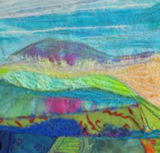 |
Curriculum Map
| Autumn Year A | Year B | Spring Year A | Year B | Summer Year A | Year B | |
| FS | Expressionism Van Gogh | Expressionism Kandinsky | Pointillism Seurat | Pointillism Signac | Sculpture Goldsworthy | Sculpture Hepworth |
| KS1 | Expressionism Matisse | Expressionism Klee | Cubism Picasso | Cubism? Arcimboldo | Sculpture Jeff Koons | Sculpture Pollock |
| LKS2 | Impressionism Monet | Impressionism Renoir | Modern Warhol | Modern Pollock | Sculpture Richard Long | Sculpture Henry Moore |
| UKS2 | Graffiti Banksy | Graffiti Kobra | Surrealism Dali | Surrealism Kahlo | Sculpture Otobong Nkanga | Sculpture Anthony Gormley |
The curriculum at Skelton is accessible to all pupils, regardless of background or need.
Impact
In order to effectively design tasks it is imperative that the classroom teacher understands fully the success that pupils have had with their learning. We use our purpose built App to track skills progress across.
It is worth noting that we define success in our curriculum beyond the assessment of the foundation subjects. We also look to build self –belief and respect so that all children develop a sense of self-worth. We hope to see the children realise new skills and find new interests and talents along their learning journey.
If you would like to know more about our Art curriculum, please email office@skeltonprimaryschoool.co.uk