
Design Technology
Design and Technology at Skelton Primary School
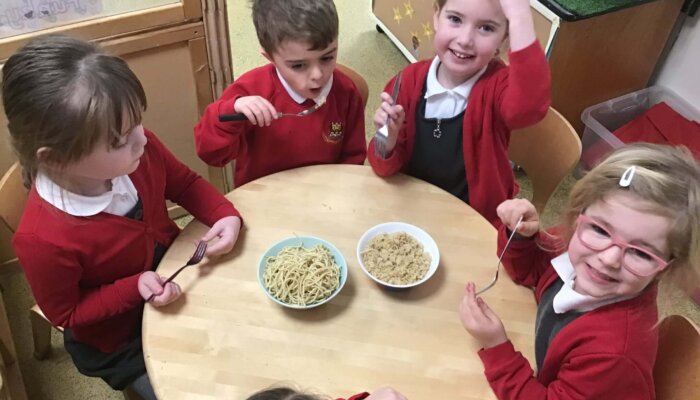
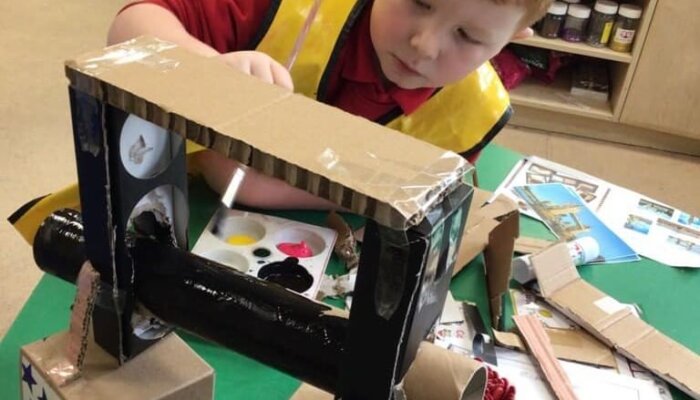
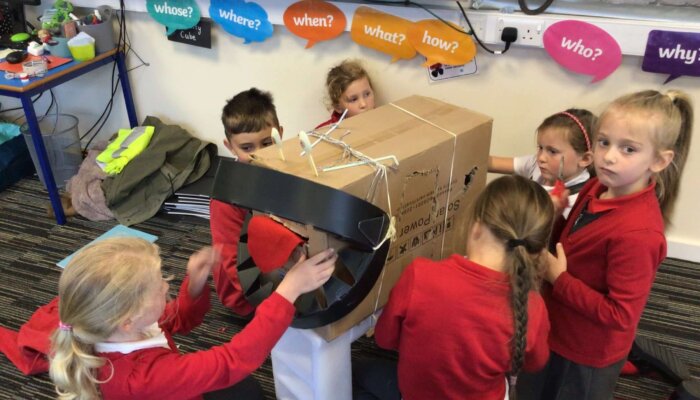
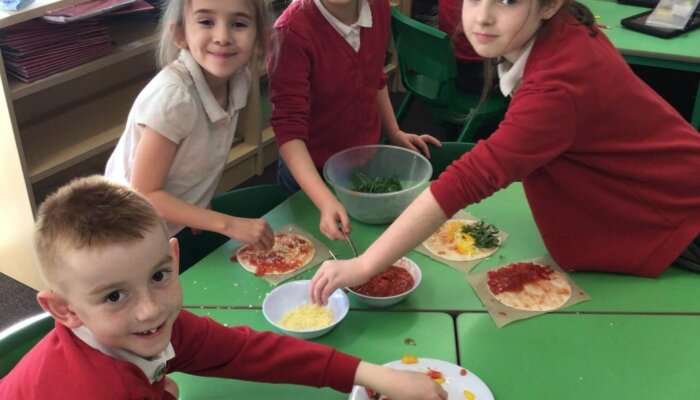
DT at Skelton Primary School is taught through the Big Ideas Curriculum. The purpose is to develop all pupil’s skills and knowledge in design, structures, mechanisms, electrical control and a range of materials, including food. Design and Technology encourages children’s creativity and encourages them to think about important issues. In our local area many of our children will go into careers that require these skills and so this is purposeful learning.
Intent
As designers our children are given a real-life context for learning. We teach them to be inspired by real world opportunities and relevant problems. We encourage them to become creative and resourceful problem solvers, working both independently and as members of a team. Our curriculum follows the design, make and evaluate cycle and is rooted in technical knowledge and skills which builds across the key stages. The learning and skills that are developed, will link with many other subjects such as mathematics, science, engineering, computing and art. By teaching these skills, we hope to raise aspirations and inspire our children to realise the opportunities that design can offer them.
Implementation
Ready, Reflective, Respectful, Responsible, Resilient
In Early Years
The EYFS has many opportunities for children to develop elements of Design and technology whilst working towards the Early learning Goals.
| Expressive Arts and Design | Understanding the World | Maths |
| Return to and build on their previous learning, refining ideas and developing their ability to represent them. • Create collaboratively, sharing ideas, resources and skills | Explore the natural world around them. | Select, rotate and manipulate shapes in order to develop spatial reasoning skills. • Compose and decompose shapes so that children recognise a shape can have other shapes within it, just as numbers can. • Continue, copy and create repeating patterns. • Compare length, weight and capacity |
| Literacy | Physical Development | PSE |
| Use some of their print and letter knowledge in their early writing. | Develop their small motor skills so that they can use a range of tools competently, safely and confidently. Suggested tools: pencils for drawing and writing, paintbrushes, scissors, knives, forks and spoons. | Show resilience and perseverance in the face of challenge. • Manage their own needs. |
In Key Stage 1
Through a variety of creative and practical activities, pupils are taught the knowledge, understanding and skills needed to engage in the process of designing and making. Pupils should work in a range of relevant contexts [for example, the home and school, gardens and playgrounds, the local community, industry and the wider environment].
In DT pupils are taught to:
Design
design purposeful, functional, appealing products for themselves and other users based on design criteria generate, develop, model and communicate their ideas through talking, drawing, templates, mock-ups and, where appropriate, information and communication technology.
Make
- select from and use a range of tools and equipment to perform practical tasks [for example, cutting, shaping, joining and finishing]
- select from and use a wide range of materials and components, including construction materials, textiles and ingredients, according to their characteristics
Evaluate
• explore and evaluate a range of existing products evaluate their ideas and products against design criteria
Develop technical knowledge
- build structures, exploring how they can be made stronger, stiffer and more stable
- explore and use mechanisms [for example, levers, sliders, wheels and axles], in their products
In Key Stage 2
Through a variety of creative and practical activities, pupils should be taught the knowledge, understanding and skills needed to engage in an iterative process of designing and making. They should work in a range of relevant contexts [for example, the home, school, leisure, culture, enterprise, industry and the wider environment]. When designing and making, pupils should be taught to:
Design
- use research and develop design criteria to inform the design of innovative, functional, appealing products that are fit for purpose, aimed at individuals or groups
- generate, develop, model and communicate their ideas through discussion, annotated sketches, crosssectional and exploded diagrams, prototypes, pattern pieces and computer-aided design
Make
- select from and use a wider range of tools and equipment to perform practical tasks [for example, cutting, shaping, joining and finishing], accurately
- select from and use a wider range of materials and components, including construction materials, textiles and ingredients, according to their functional properties and aesthetic qualities
Evaluate
- investigate and analyse a range of existing products • evaluate their ideas and products against their own design criteria and consider the views of others to improve their work
- understand how key events and individuals in design and technology have helped shape the world
Develop technical knowledge
- apply their understanding of how to strengthen, stiffen and reinforce more complex structures
- understand and use mechanical systems in their products [for example, gears, pulleys, cams, levers and linkages] • understand and use electrical systems in their products [for example, series circuits incorporating switches, bulbs, buzzers and motors]
- apply their understanding of computing to program, monitor and control their products.
Projects on a Page
In order to learn these skills children will be complete termly DT projects as part of their learning journey.
| Year A | Autumn | Spring | Summer |
|---|---|---|---|
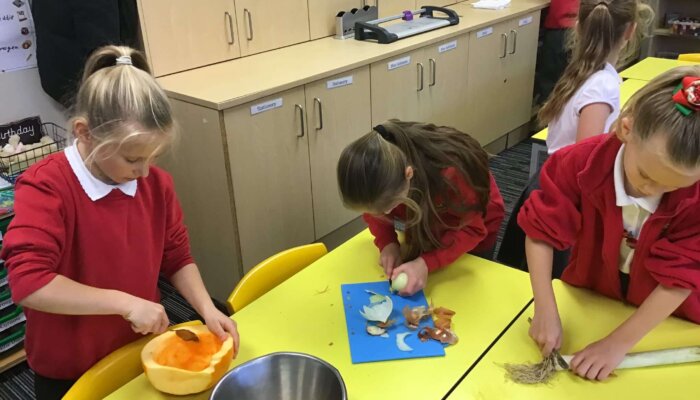
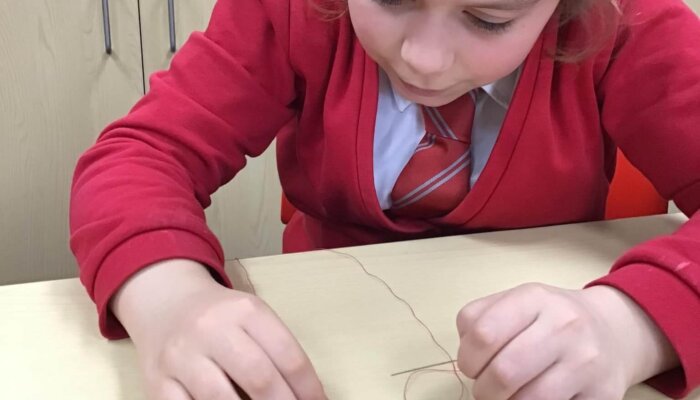
| KS1 | Food- preparing fruit and veg | Mechanisms- sliders and levers | Textiles-Templates and joining |
| LKS2 | Food- healthy and a varied diet | Mechanisms-levers and linkages | Textiles-2D shape to 3D product |
| UKS2 | Food-celebrating culture and seasonality | Mechanisms- Cams | Textiles-Combing different fabric shapes |
| Year B | Autumn | Spring | Summer |
|---|---|---|---|
| KS1 | Food-preparing fruit and veg | Mechanisms-Wheels and axles | Textiles-Templates and joining |
| LKS2 | Food- healthy and a varied diet | Mechanisms-Pneumatics | Textiles-2D shape to 3D product |
| UKS2 | Food-celebrating culture and seasonality | Mechanisms-Pulleys or gears | Textiles-using CAD in textiles |
Impact
In order to effectively design tasks it is imperative that the classroom teacher understands fully the success that pupils have had with their learning. We use our purpose built App to track skills progress across Design Technology.
It is worth noting that we define success in our curriculum beyond the assessment of the foundation subjects. We also look to build self –belief and respect so that all children develop a sense of self-worth. We hope to see the children realise new skills and find new interests and talents along their learning journey.
Appendix A – Assessment Points
| Year A | Year B | |
|---|---|---|
| Key Stage 1 (1&2) | Evaluate, Design, Make – Can explain what they have made and which materials they are using – Can design products that have a clear purpose | Evaluate, Design, Make – Can design a product for a chosen user and purpose based on simple design criteria, Can select from and use a range of tools and equipment to perform practical tasks such as marking out, cutting, joining and finishing. Can evaluate their ideas throughout and their products against original criteria. |
| Construction – With support can cut wood/dowel using hacksaw- Can build simple structures with construction kits. | Construction – Has explored and used wheels, axles and axle holders. Can distinguish between fixed and freely moving axles. | |
| Cooking and Nutrition – Can group familiar foods – Can cut ingredients safely using a knife – Can prepare simple dishes safely and hygenically | Cooking and Nutrition – Can use simple utensils and equipment to e.g. peel, cut, slice, squeeze, grate and chop safely, Understands where a range of fruit and veg comes from. | |
| Lower Key Stage 2 (3&4) | Evaluate, Design, Make – Can investigate existing products – Can generate designs with annotated sketches – Can identify strengths and weaknesses of their design ideas – Can talk about how closely their finished product meets their design | Evaluate, Design, Make – Can generate realistic and appropriate ideas and their own design criteria, Can use annotated sketches and prototypes to develop, model and communicate ideas, Can order the main stages of making, Can select from and use appropriate tools with some accuracy to cut and join materials, Can select from and use suitable finishing techniques |
| Construction – Can strengthen frames using diagonal struts – Canuse mechanical systems in their products e.g. gears, pulleys and levers. | Construction – Understand and use pneumatic mechanisms, Know how to strengthen, stiffen and reinforce existing fabrics | |
| Cooking and Nutrition – Can cut ingredients accurately and safely by selecting appropriate tools – Can measure and weigh ingredients appropriately (grams) | Cooking and Nutrition – Can plan the main stages of a recipe, listing ingredients, utensils and equipment, Can select and use appropriate utensils and equipment to prepare and combine ingredients. | |
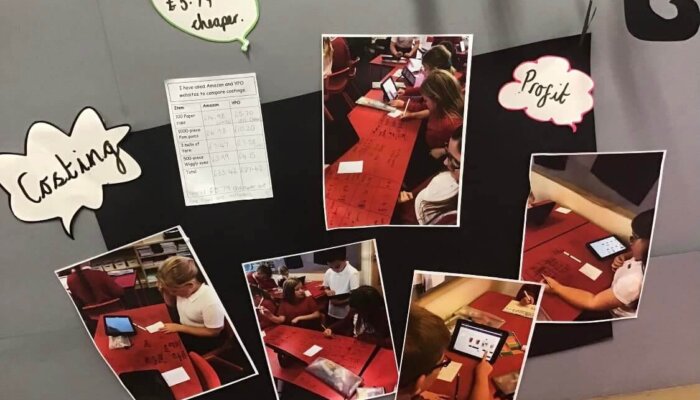
| Upper Key Stage 2 | Evaluate, Design, Make – Can undertake research to inform design process – Can use diagrams and CAD software to represent design – Can give a high quality finish – Can make suggestions on how their design/product could be improved. | Evaluate, Design, Make – Can generate innovative ideas by carrying out research using surveys, interviews, questionnaires and web-based resources, Produce detailed lists of tools, equipment and materials, Can compare the final product to the original design specification |
| Construction – Can join materials using appropriate methods – Can use a hand drill to drill tight and loose fit holes – Can use electricity and wires in models | Construction – Understand that mechanical and electrical systems have an input, process and an output | |
| Cooking and Nutrition – Can assemble or cook ingredients, controlling the temperature of the oven or hob if cooking – Can measure accurately using different equipment – Can create recipes, including ingredients, methods, cooking times and temperatures. | Cooking and Nutrition – Can write a step-by-step recipe, including a list of ingredients, equipment and utensils, Can make, decorate and present the food product appropriately for the intended user and purpose |
If you would like to know more about our Design & Technology curriculum, please email office@skeltonprimaryschoool.co.uk